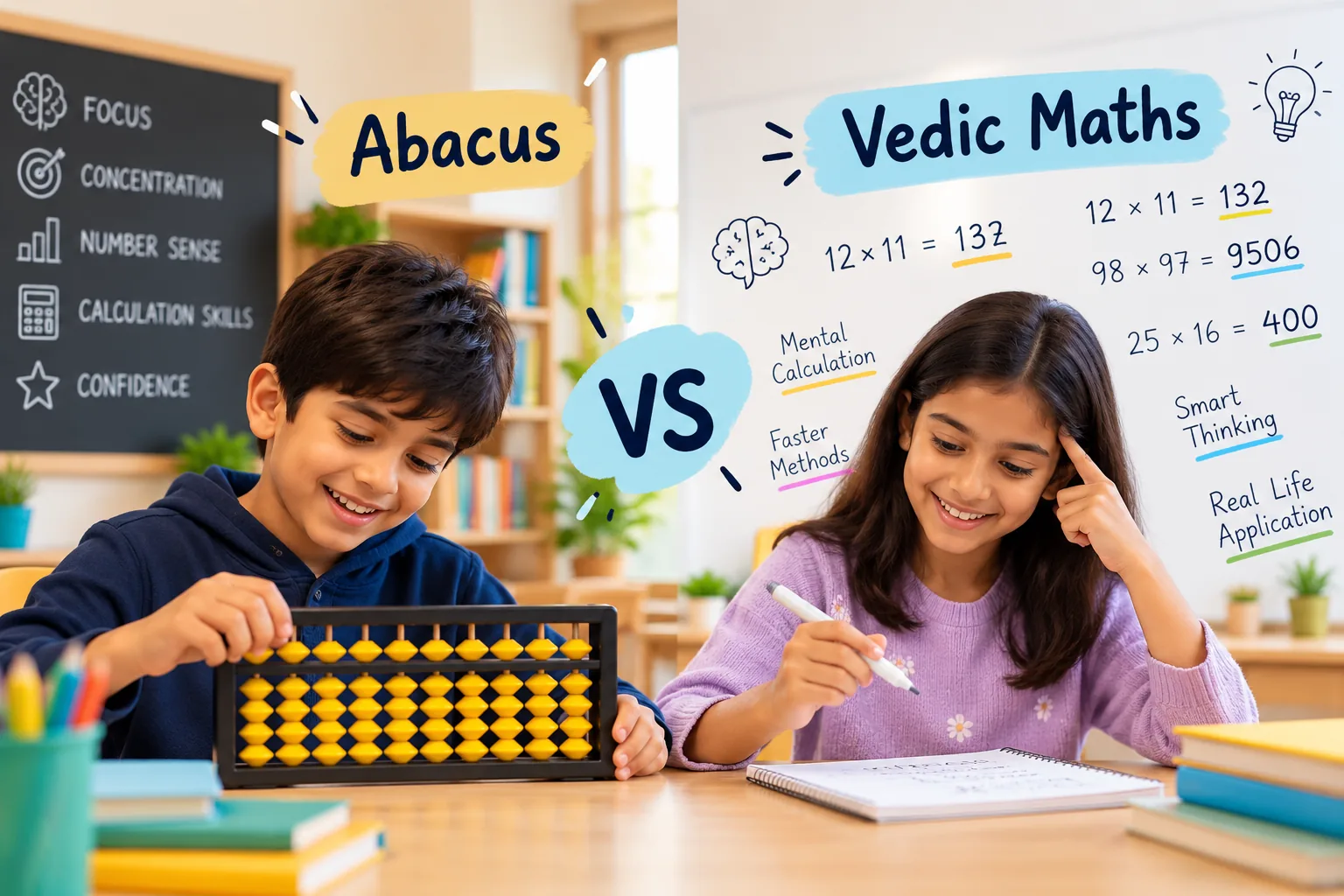
Abacus or Vedic Maths? Here’s the honest answer: it depends on your child’s age and how they think. Abacus is a hands-on tool that builds number sense in younger kids, usually 5-8. Vedic Maths is a set of clever shortcuts that suits kids who already know their basics, usually 8 and up. Many children enjoy both, one after the other.
Still unsure? Take the 4-question quiz below, then try a real Vedic Maths trick yourself. Fair warning: it’s a little addictive. 😄
- Abacus suits ages 5-8: it turns numbers into beads you can see and touch.
- Vedic Maths suits ages 8 and up: it teaches mental shortcuts for faster calculation.
- Vedic Maths comes from a 1965 book of 16 short rules, called sutras.
- They work best in sequence: Abacus builds the foundation, Vedic Maths adds speed.
What is the difference between Abacus and Vedic Maths?
Abacus uses a physical bead frame to represent numbers, so children “see” maths before doing it mentally. Vedic Maths uses short rules for mental calculation, popularised by the 1965 book Vedic Mathematics with its 16 sutras. In short: Abacus trains visualisation and focus, while Vedic Maths trains flexible, faster ways to calculate.
| 🧮 Abacus | ⚡ Vedic Maths | |
|---|---|---|
| Best age | 5-8 years | 8-14 years |
| How it works | Moving beads on a frame, then picturing them in the mind | Short rules (sutras) for mental calculation |
| Builds | Number sense, concentration, visual memory | Speed, accuracy, number flexibility |
| Feels like | A hands-on game | Learning magic tricks with numbers |
| Great for | Young kids who learn by touching and seeing | Kids who know their tables and want to get faster |
Which one fits my child? Take the quiz
Every child learns differently. Answer four quick questions and we’ll point you in the right direction.
Why is Abacus great for younger kids?
Abacus works because young children think in pictures. Sliding a bead to show “7” is far easier to grasp than the symbol 7 on paper. Over time, kids start picturing the abacus in their head and calculating with it, which also stretches their concentration and memory.
Why parents love it: it feels like play, so even kids who “hate maths” happily practise. That positive start often matters more than any single skill.
Why is Vedic Maths great for older kids?
Vedic Maths shines once a child knows the basics. Instead of long, step-by-step working, they learn short patterns that make many calculations quicker, and a fast way to check their own answers. It’s less about memorising and more about seeing how numbers fit together.
Want proof? Try the trick below. It’s one of the first ones kids learn, and it always gets a “whoa”.
One more trick: to square a number ending in 5, multiply the first digit by the next number, then stick 25 on the end. 35 × 35? 3 × 4 = 12, so the answer is 1225. Try 65 × 65 yourself. (Answer: 4225!)
Should my child learn both?
Often, yes, and in order. Abacus from about 5-8 builds the number sense and focus, then Vedic Maths from about 8 adds speed and flexible thinking. They don’t compete with school maths either: both give kids extra ways to understand what they’re already learning in class.
Where can my child learn Abacus and Vedic Maths in Panchkula?
At our Sector 21 centre, we run abacus classes and Vedic Maths classes for kids in Panchkula in small groups, with lots of practice games. Can’t make it to the centre? We also teach online Vedic Maths classes live, from home.
Frequently asked questions
What is the right age to start Abacus?
Is Vedic Maths useful for school exams?
How long before we see a difference?
Can my child do Abacus and Vedic Maths at the same time?
Not sure which to choose? Let’s find out together 🧮⚡
Book a free trial class and we’ll suggest the right fit for your child.
Book a Free Trial See Maths ProgramsSources: Wikipedia, Vedic Mathematics (1965 book by Bharati Krishna Tirtha, 16 sutras). Retrieved October 2026.